Crying in H-Mart: A Review of a Memoir That Peaked in Its First Chapter
Spoilers ahead (though fair warning, there isn’t much to spoil).
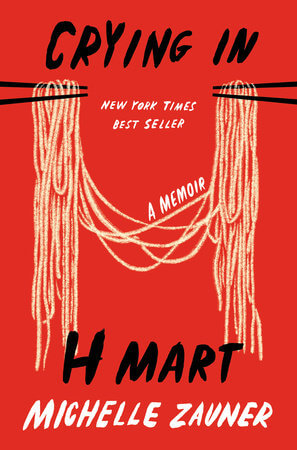
Crying in H-Mart is Michelle Zauner’s memoir about grieving her Korean mother, and the food and culture that tied them together. The premise honestly got me: a young woman loses her mom, and the only way back to her is through Korean grocery stores, through cooking, through all the things they shared that didn’t need words. Zauner is the musician behind Japanese Breakfast, and you can feel the songwriter in her. At her best, she has a real intimacy to her writing that’s hard to fake. I wanted to love this book. I really did.
A note on the missing middle section: I usually dedicate a section to characters, but this is a memoir; these are real people. It didn’t feel right to dissect them the way I would a novel’s cast. That said, how Zauner portrays herself and her mother is impossible to ignore, and I’ll get to that.
My Honest Review
The first chapter was originally a standalone essay published in The New Yorker, and it shows. It’s specific and personal and an incredible essay. She writes about watching Korean women cry in H-Mart, about food as the last language she and her mother shared. I reread it multiple times. I would give the first chapter 5 stars.
And then the rest of the book happened.
What follows is competent writing. It’s earnest, relatively clear, and occasionally amiable, but not what the first chapter promised. A reviewer on the back cover called it lyrical. I’d disagree. Lyrical writing has a pull to it, a rhythm that carries you even when nothing much is happening. This doesn’t have that. It’s plain, and for most of the book, plain is fine, except that the story isn’t doing enough on its own to carry it.
I always say you need one of two things to make a decent book: interesting/good writing or an interesting/good story. Unfortunately, I feel like, apart from the first chapter, Crying in H-Mart had neither.
The bigger issue is that the book doesn’t really go anywhere. The entirety of the book felt like scenes piling up to get to an amazing resolution. I was anticipating the last chapter to have this grand moment of understanding, but the last chapter was just the same as the second. But I want to be clear–journaling is great. Getting emotions out of your head and onto paper is valuable. But there’s a version of that which stays private, and a version that gets shaped into something a reader can enter. This reads like the former. Like journal entries that were published before anyone asked the questions: what is this building toward? What do I want the reader to leave with? I kept waiting for some late insight that would reframe everything. It never came.
And I want to say, I have genuine respect for Zauner for putting this out there at all. Writing about personal experiences is hard. Putting your name on it and publishing it takes real courage. But courage alone doesn’t make a book work, and this one needed more time and a much stronger editorial hand.
What made that worse was how Zauner writes about herself and her mother. She is hard on both of them, which I respect in theory (honest memoirs don’t need to be flattering, and even shouldn’t). But there’s a difference between honesty and just leaving things unexamined. Her mother comes across as cold and even cruel, and Zauner doesn’t do much to complicate that portrait. There’s a scene where Zauner falls, and her mother scolds her rather than comforting her. Zauner doesn’t reflect on the scene much or acknowledge anything about it. And Zauner herself is relentlessly self-critical in a way that started to exhaust the reader–not even because it’s dishonest, but because it goes nowhere.
I love Japanese Breakfast. I loved the premise. Food, identity, loss, the specific weirdness of growing up between two cultures, that’s amazing material. But a great premise and one great chapter don’t make a great book.
Happy reading, just maybe read the essay version of this one.