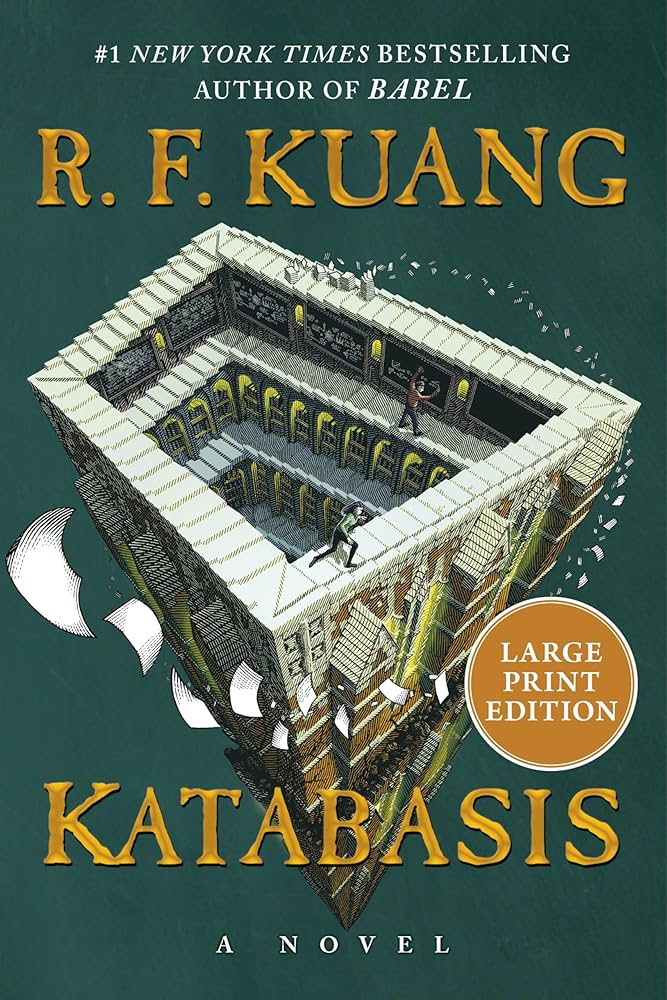
Katabasis:
A Spoiler-Free Review
of a Book Worth the Descent
Katabasis is R.F. Kuang’s latest novel, a dark, research-heavy descent into a world inspired by Dante’s Inferno, following Alice, a scholar who travels into the underworld on a mission that is equal parts academic and deeply personal. If you’ve read Kuang before, you know what you’re signing up for: dense, confident writing, a magic system rooted in real intellectualism, and characters who are never quite who you think they are. Katabasis delivers all of that, and then some.
Alice Law
Alice is fascinating and frustrating in equal measure, which I suspect is entirely intentional. She is driven and not entirely trustworthy as a narrator (or at least that’s what I kept asking myself). Her motivations shift in ways that are either brilliantly layered or underexplained, depending on which chapter you’re in. Her relationship with Grimes in particular raises questions that the book doesn’t always bother to answer cleanly. Does she want to save him? Control him? Both? I’m genuinely not sure, and I go back and forth on whether that ambiguity is a strength or a problem.
Peter Murdoch
Peter is where the book lost me and gained me all at once. First half: He was marketed (heavily) as the academic rivals to lovers interest, and I went in expecting that. In my opinion, he isn’t, at least not really. Their dynamic is interesting enough on an intellectual level, but the romantic undertone never quite lands. Second half: Peter as a character, separate from the romance, is genuinely compelling. He is nerdy and warm and has an interesting backstory.
Elspeth
Elspeth is one of those characters who arrives and immediately makes the book feel richer. This will be brief to keep it spoiler free: now operating a patchwork barge on the River Lethe, she is the guide Alice and Peter didn’t know they needed, and the one who sees through both of them almost immediately. She is cynical about academia, and yet there is a warmth underneath that cynicism.
The Kripkes
The Kripkes are Nicomachus and Magnolia, two magicians who faked their deaths to quest through Hell and stayed, becoming predators who hunt the living for their blood. They travel with their dead child, Theophrastus, which tells you everything you need to know about the register of horror Kuang is working in here. What makes them genuinely unsettling is their backstory (again, keeping it brief not to spoil): they were scorned by the academic world in life, and Hell became their revenge.
My Honest Review
Let me start with what Katabasis does extraordinarily well, because it does quite a lot. The research is staggering. You can feel the weight of it on every page, the mythology, the theology, the history, and unlike lesser authors who wear their research as a costume, Kuang wears it as a second skin. It never feels like showing off. It feels like someone who genuinely knows this world and is inviting you into it. The writing, as always, is phenomenal. Full of vivid description and confident in a way that makes even the densest passages a pleasure to read.
The first half of this book is everything I wanted. And let me just say, the first chapter is one of the best first chapters I have ever read in this genre. The descent through the early circles is atmospheric and tense and full of the kind of intellectual richness that made Babel so extraordinary. Kuang builds a world that feels genuinely alive, and the momentum through the circle of Dis is propulsive.
And then, somewhere after Dis, the momentum stalls. The worldbuilding that had been so careful and immersive starts to thin out, and what follows feels less like a journey through a fully realized underworld and more like characters walking through increasingly bare rooms. The circles blur together. The sense of place that made the early chapters so gripping quietly evaporates. And for a book so rooted in Dante, a text defined by its vivid, specific geography, that’s a significant loss.
I keep comparing it to Babel, which is maybe unfair, but I think it’s the right comparison. Babel’s world felt airtight, every detail in service of a larger whole, every setting as richly imagined as the last. Katabasis reaches that height in its first half and then lets it slip. That said, I want to be clear: this is still a book I would recommend. Kuang is one of the most talented writers working today, and even a slightly uneven Kuang novel is better than most things on the shelf. Four stars, and a request for more Krypques.
Happy reading!