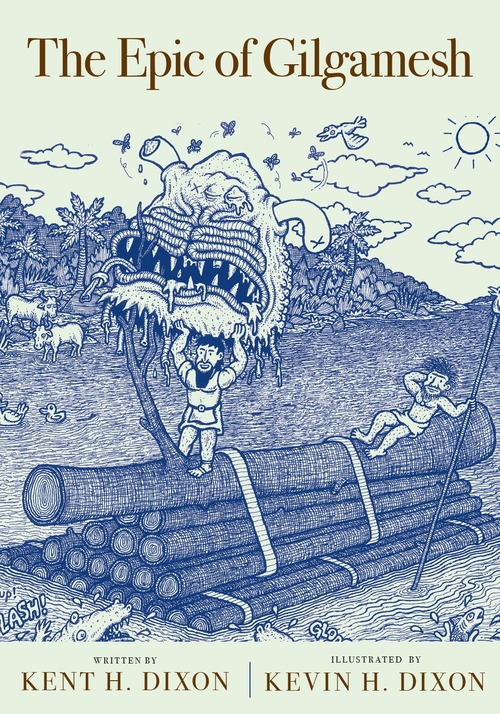
The Oldest Story Ever Told: A Review of The Epic of Gilgamesh
review by lalie lours
March 09, 2026

The Oldest Story Ever Told: A Review of The Epic of Gilgamesh

Book Title:
The Epic of Gilgamesh
Author: Anonymous
Written in 1300 BCE

Warning: This review is not spoiler-free!

I came to Gilgamesh through a HarvardEdX course on ancient world literature. I read it on my laptop in pajamas. I have zero regrets.

Here’s what surprised me: the oldest story ever written is not really about heroism. It’s about failure. Gilgamesh fails to defeat death, fails to obtain immortality, and at one point loses a magical plant of eternal youth to a river while he was napping. And yet the poem doesn’t end in despair. He returns to Uruk, looks at its walls (his city, his legacy), and something finally clicks.

The Epic of Gilgamesh, the worlds oldest epic poem, manages to whisper a message across 4,000 years: you will die, but what you build and love might not. For something this old, it still lands surprisingly.

As for man, his days are numbered, whatever he might do, it is but wind.

Gilgamesh

At the opening, Gilgamesh is not a hero but a problem. A very, very big problem. He’s a mess of unchecked power, a restless ego, and two-thirds god with apparently limited self-awareness. The epic is his arc from tyrant to someone who has genuinely earned a moment of peace. What makes it work is how modern his anxiety feels (the terror of death, the search for a legacy). He is the first literary protagonist to have an existential crisis, which makes him so memorable.

The story solves the “problem” of Gilgamesh by introducing someone who can actually challenge him: Enkidu.

Enkidu is the first person strong enough to meet Gilgamesh head-on, and their clash turns into one of literature’s earliest great friendships. Through Enkidu, Gilgamesh learns limits. He learns companionship.

The real break in Gilgamesh’s arc comes with (spoiler) Enkidu’s death. Up to that point, the epic still moves like a heroic adventure (I will even argue later that it follows the Hero’s journey structure)—monsters slain, reputations secured, glory loudly claimed. But when Enkidu dies, Gilgamesh encounters something his strength cannot fix. His grief strips away the arrogance that defined him at the start. For the first time, he understands that the fate awaiting Enkidu is also waiting for him.

Enkidu

If Gilgamesh is civilization, Enkidu is everything it displaced. Raised among animals, shaped by the gods as a counterweight to a king with too much of everything—their friendship is the heart of the poem. Gilgamesh gains empathy; Enkidu gains culture. The tragedy is that culture comes at a cost. Enkidu’s awakening into human consciousness is also, quietly, his march toward death. It’s one of the earliest meditations on what it costs to become human, and it hasn’t aged a day.

Enkidu begins as something almost mythically innocent. He runs with the animals, drinks at their watering holes, and disrupts traps meant for them. In other words, he exists outside the structures that define human life: cities, hierarchies, ambition, legacy. The gods make him specifically to slow Gilgamesh down, but in doing so they create a figure who represents an entirely different way of being in the world.

His transformation is abrupt and symbolic. Through his encounter with Shamhat, Enkidu loses his place among the animals and gains entry into human society. The animals no longer recognize him. He eats bread, drinks beer, learns language and clothing and custom.

That vulnerability becomes clear once he enters the world of heroes. Enkidu joins Gilgamesh in the great adventures of the epic, helping defeat monsters and defy the gods. For a moment, it looks like he has fully crossed over into the heroic world of fame and story. But unlike Gilgamesh, Enkidu is fully mortal. The gods’ punishment falls on him, not the king who began the trouble.

His death is therefore doing double work in the poem. It is the emotional center of the story (the loss that breaks Gilgamesh), but it is also the logical end of Enkidu’s transformation. The moment he becomes fully human, he inherits the defining human condition: the knowledge that life ends. In that sense, Enkidu’s arc is smaller than Gilgamesh’s but just as profound. He begins outside humanity and dies having fully joined it.

Shamash & Ishtar

Shamash is the moral compass — the divine figure who actually seems fond of Gilgamesh and nudges him, gently, toward wisdom. Ishtar is something else entirely: goddess of love and war, and not someone who takes rejection gracefully. When Gilgamesh turns her down, she responds by unleashing the Bull of Heaven. The poem doesn’t ask you to condemn her for it. That ambivalence is part of what makes the gods here feel genuinely mythic rather than cartoonish.

Siduri

My favorite character, if I’m being honest. Siduri is a tavern keeper at the edge of the world who meets Gilgamesh mid-spiral — grief-stricken, wild, searching — and offers him wine and something close to wisdom: enjoy your life, love those beside you. She’s barely in the poem. She might be its quiet center anyway.

My Honest Review

The Epic of Gilgamesh is not a heroism story. It is a failure story, and that’s precisely what makes it extraordinary. Gilgamesh fails to defeat death, fails to obtain immortality, and loses the plant of eternal youth to a river while napping. By every conventional measure, he loses. Yet the poem ends not with despair but with a kind peace. He returns to Uruk, looks at its walls, and the text asks you to find that sufficient. Remarkably, you do.

What’s fascinating is that the poem actually resembles what we now call the Hero’s Journey, even though it predates the concept by millennia. Gilgamesh begins as a tyrannical king (the ordinary world), encounters his transformative companion in Enkidu (the threshold moment), and launches into a series of mythic trials: the defeat of Humbaba, the killing of the Bull of Heaven, the long wandering in search of eternal life. Structurally, the epic hits many of the beats modern readers associate with heroic storytelling. The difference is in the ending. Where the typical heroic cycle returns with a triumphant prize, Gilgamesh returns empty-handed. The prize he brings back is not immortality but a change in perspective.

What stays with me is how little distance there is between Gilgamesh and any modern reader. None of it has aged. The poem doesn’t dress these feelings up or resolve them neatly. It just holds them, seriously and without flinching, which is more than most contemporary literature manages. The grief after Enkidu’s death in particular feels startlingly immediate: a king who once terrorized his own city suddenly wandering the wilderness because he cannot accept that someone he loves is gone.

Happy reading, and make sure not to lose any plants!

Our website uses cookies

Our website use cookies. By continuing, we assume your permission to deploy cookies as detailed in our Privacy Policy.