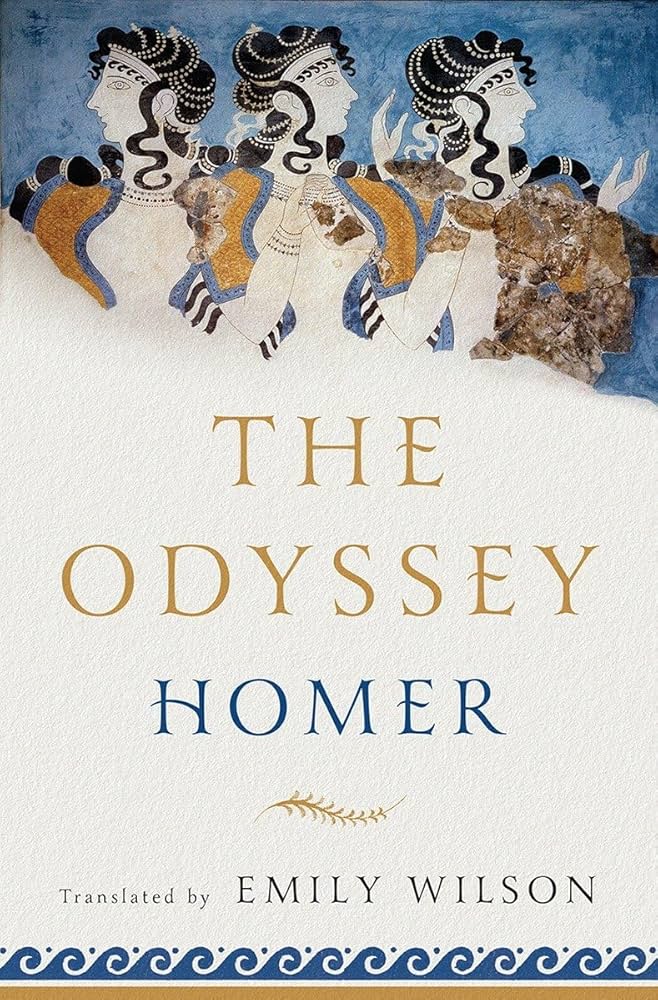
The Odyssey:
A Comparative
Review
of Translations
Let me be upfront: this is not a review of The Odyssey. Because how do you review The Odyssey? It’s like reviewing the ocean. Homer’s epic has been retold, reimagined, translated, and fought over for nearly three thousand years, and it will outlast every opinion anyone has ever had about it, including mine. What this is, instead, is a comparison of the translations I’ve read in preparation for the upcoming Christopher Nolan film, because if Nolan is about to put the Odyssey on the biggest possible screen, I wanted to show up having done my homework.
I’ve read three translations: Robert Fagles, Emily Wilson, and Philippe Jaccottet in French. Here’s where I landed.
Emily Wilson
Wilson’s 2017 translation was the first by a woman. It might not sound important, and I’m not one to put her on a pedestal soley because she is a woman, but Wilson wrote it well. The Odyssey is a poem full of women (Penelope, Circe, Calypso, Athena), and they have spent centuries being filtered through translators who were, to put it plainly, not particularly interested in them. Wilson is. The women of the poem feel like people rather than furniture, and that is what makes Wilson’s translation so great.
The other thing Wilson does is write in plain, confident English. No archaisms, no theatrical flourishes, no sense that you are being reminded at every turn that this is An Ancient Text. It has momentum. Reading it feels like being told a story by someone who knows it completely and trusts you to keep up. For a first-time reader or someone coming back after years away, I can’t think of a better entry point. It’s incredibly accessible.
Robert Fagles
Fagles is the translation most people encounter first, and there’s a reason it became the standard. It’s magnificent. Where Wilson is clean and direct, Fagles is expansive and for lack of a better term, musical. His lines have a grandeur to them that feels genuinely epic in the old sense of the word.
The tradeoff is that it can feel heavy going at stretches. The elevated tone that makes the set pieces soar can also make the quieter moments feel more laborious than they should. But for sheer poetic ambition, Fagles earns every bit of his reputation.
Philippe Jaccottet (French)
Reading Jaccottet was a different experience entirely, partly because French, and partly because Jaccottet is himself a poet of real distinction, which shows. His translation has an elegance and restraint that feels very French in the best sense: precise, considered, never showy. I found it harder to settle into than Wilson or Fagles, but that’s as much about reading in a second language as anything else. What I took from it was a reminder of how much any translation is also an act of interpretation.
My Honest "Review"
If you’re asking which translation to read, my answer is Wilson, but the honest answer is that it depends on what you’re looking for.
Wilson is the most alive. She writes as though the poem belongs to right now, not to a museum, and that energy is infectious. Her choices are sometimes controversial among classicists, her famous opening line translates Odysseus not as “cunning” or “resourceful” but as simply “complicated,” which is a whole essay in one word — but they are always deliberate and always interesting. She has a point of view, and it sharpens the poem rather than flattening it.
Fagles is the most beautiful. If you want to feel the full weight of the epic tradition, the sense that you are reading something ancient and enormous, Fagles delivers that in a way Wilson’s leaner prose doesn’t quite reach for.
Jaccottet reminded me that the Odyssey exists beyond English, beyond any single tradition, and that every translation is also a portrait of its translator.
I’m reading all of this with one eye on the Nolan film, which is either a ridiculous way to approach Homer or a completely reasonable one. The Odyssey has always been about the journey home–and whatever form that takes, on the page or on screen, the story has a way of finding you exactly where you are.
Happy reading — and may your journey home be shorter than Odysseus’s.