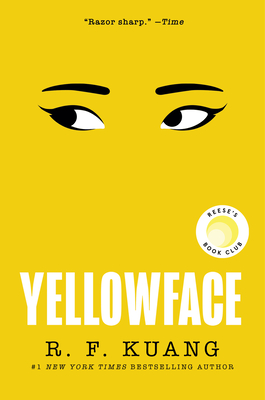
R. F. Kuang's Yellowface Review:
A Brilliant Satire of Publishing
This is a spoiler-free review.
Yellowface follows June Hayward, a struggling author whose wildly successful friend, Athena Liu, dies in a freak accident right in front of her. In the aftermath, June makes a split-second decision that changes the course of her life: she takes Athena’s unpublished manuscript and, after convincing herself she has “improved” it, publishes it as her own.
What follows is June’s psychological unraveling. As the novel explores the fallout of literary theft, it also dives headfirst into questions of race, cultural appropriation, authorship, and the publishing industry’s obsession with diversity, marketability, and public image. Told entirely through June’s perspective, Yellowface blurs the line between truth and self-deception, forcing readers to spend hundreds of pages inside the mind of someone who is constantly rewriting reality to justify her own actions.
June Hayward
I don’t think I’ve ever been so conflicted by a narrator.
June is selfish, insecure, ambitious, and constantly trying to justify every terrible decision she makes. The fascinating part is that Kuang writes her so convincingly that, even when you know she’s wrong, you occasionally catch yourself understanding her logic.
She’s also one of the most unreliable narrators I’ve read in a long time. Every event is filtered through her perspective, and because she’s constantly rewriting reality to make herself the victim, you’re left questioning everything. I love unreliable narrators when they’re done well, and Kuang absolutely nails it here.
Athena Liu
Athena is present throughout the novel even when she isn’t physically on the page. She’s brilliant, successful, admired, and becomes almost mythical through June’s eyes.
What I appreciated most is that Kuang never lets Athena become a perfect symbol. Like everyone else in the novel, she’s complicated. She’s talented, yes, but she’s also human. That complexity keeps the story from becoming a simple battle between good and evil.
The Publishing Industry
Normally I dedicate this section to another character, but honestly, the publishing industry almost feels like one itself.
Publishing is portrayed as competitive, performative, and constantly shaped by public opinion. Social media, marketing, internet discourse, and public perception all become forces that influence every decision. It makes for an incredibly entertaining backdrop and adds another layer to June’s unraveling.
My Honest Review
R.F. Kuang has become one of those authors whose books I’ll pick up almost immediately, and Yellowface reminded me why.
Like Babel and Katabasis, the opening chapter is phenomenal. Kuang has a talent for writing first chapters that immediately grab your attention, and Yellowface might have my favorite opening of hers. Within a few pages, I was completely invested and genuinely couldn’t stop reading.
What impressed me most was how psychologically manipulative the novel is—in the best way possible. You’re constantly rooting against June. You want her to get caught. You know she deserves consequences.
…And then Kuang does something almost annoying: she makes you hope she’ll get away with it. Not because you suddenly think she’s a good person, but because you’re trapped inside her head. You understand every rationalization she makes, every excuse, every attempt to convince herself she’s the real victim. It’s uncomfortable, fascinating, and incredibly well executed.
I also loved how believable the story felt. Nothing that happened ever struck me as impossible. Every decision, every controversy, every online discourse felt like something that genuinely could happen. That realism makes the tension so much stronger because it never feels like the novel relies on outrageous twists just to shock the reader.
That said, the ending lost me a little. Without spoiling anything, it was the first time I felt the story stepped outside the grounded realism that had made the rest of the novel so compelling. Up until that point, everything felt plausible—uncomfortable, yes, but believable. The ending pushed just a little too far for me, and it took away some of the impact the rest of the book had built so carefully.
Even so, I still had an incredible time reading it. Yellowface is sharp, funny, uncomfortable, and surprisingly addictive. It asks difficult questions without pretending there are easy answers, and it’s one of those books that makes you want to immediately talk about it with someone else. If Babel showcases Kuang’s brilliance as a historian and world-builder, Yellowface showcases her understanding of people. She knows exactly how we justify ourselves, how internet culture amplifies everything, and how easy it is to convince ourselves that we’re the hero of our own story.
Four stars. A gripping satire, an exceptional unreliable narrator, and one of the best opening chapters I’ve read in years—even if the ending didn’t quite stick the landing.
Happy reading, and let this be a lesson not to steal manuscripts.